❓ Key Questions Covered in This Lesson
📋 Contents
- 1 Parts of Plant
- 2 Root
- 3 Types of Root
- 4 Food stored in roots
- 5 Leaf
- 6 Structure of leaf
- 7 Function of chlorophyll
- 8 Process of photosynthesis
- 9 Transpiration
- 10 Activity: Leaves make food by photosynthesis
- 11 Activity: To show that sunlight is necessary for Photosynthesis
- 12 Activity : Transpiration in plants
🌱 Parts of Plant
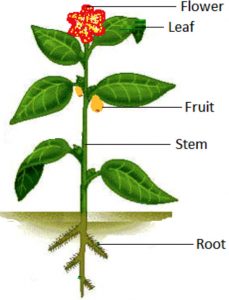
The main parts of plants are: Root, Stem, and Leaves.
🥕 Root
The main functions of roots are:
- Roots anchor the plant to the soil: Roots fix the plant firmly in the ground, preventing it from being pulled out easily or blown away by wind.
- Roots absorb water and minerals from the soil: Water and dissolved nutrients absorbed by roots are required by leaves to manufacture food.
- Roots prevent soil erosion: By holding soil particles together tightly, roots prevent soil from being washed away by water or blown away by wind.
🌿 Types of Roots
Roots are primarily divided into two main types:
- Tap Roots
- Fibrous Roots
1. Tap Root
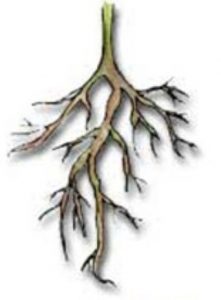
A tap root is a main straight tapering root that grows vertically down into the soil and gives out smaller branch roots on all sides.
- The main thick central root is called the tap root.
- The smaller side branches growing from it are called lateral roots.
- Examples: Pea plant, Neem tree, Mango tree, Marigold, Tulsi, Gram, Carrot, Radish, Beet, and Turnip.
2. Fibrous Root
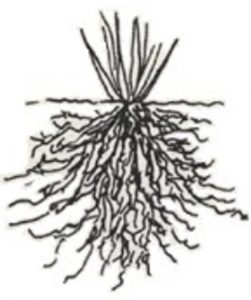
A fibrous root consists of a cluster of many thin, fibre-like roots of similar size originating from the base of the stem.
- Fibrous roots spread out widely in the topsoil and anchor the plant firmly.
- Examples: Grass, Paddy (Rice), Wheat, Maize, Sweet Potato, Millet (Bajra), Sugarcane, and Bamboo.
🥔 Food Stored in Roots
Minerals present in soil dissolve in soil water. Roots absorb this solution, and the stem transports it to the leaves. The food prepared by leaves is carried by the stem to all parts of the plant, including roots. Some plants store excess food in their roots, which we consume as vegetables (e.g., Radish, Carrot, Sweet Potato, Turnip, Tapioca, and Beetroot).
🪵 Stem
The hard, thick stem of a large tree is called the trunk, which is protected by a tough outer layer called bark.
Main Functions of the Stem:
- Holds the plant upright and erect toward sunlight.
- Carries water and dissolved minerals upwards from roots to leaves.
- Transports prepared food (sugar) from leaves to all other plant parts.
- Spreads out leaves, flowers, and fruits to receive maximum sunlight for photosynthesis.
🔬 Narrow Tubes inside the Stem
Inside the stem, two types of microscopic conducting tubes are present:
- Water-conducting tubes (Xylem): Carry water and minerals upwards from roots to leaves.
- Food-conducting tubes (Phloem): Transport food prepared by leaves down to roots and other growing organs.
🍃 Leaf & Structure
Structure of a Leaf
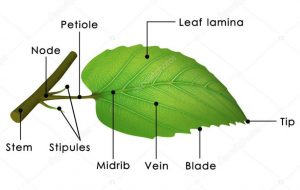
- Lamina (Leaf Blade): The broad, green, flat surface of the leaf.
- Petiole (Leaf Stalk): The thin stalk connecting the leaf blade to the stem.
- Mid-rib & Veins: The central main line is the mid-rib, from which network veins branch out to transport fluids and support leaf structure.
- Stomata: Tiny microscopic pores on leaf surfaces that regulate gas exchange ($CO_2, O_2$) and transpiration water loss.
- Chlorophyll: Green pigment that captures light energy from the sun.
☀️ Process of Photosynthesis
💧 Transpiration in Plants
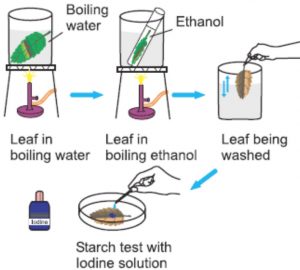
- Pluck a green leaf from a potted plant exposed to sunlight.
- Place the leaf in a beaker containing alcohol.
- Boil the beaker in a water bath to remove green chlorophyll.
- Wash the decolourised leaf thoroughly with warm water.
- Place the leaf in a petri dish and add a few drops of dilute Iodine solution.
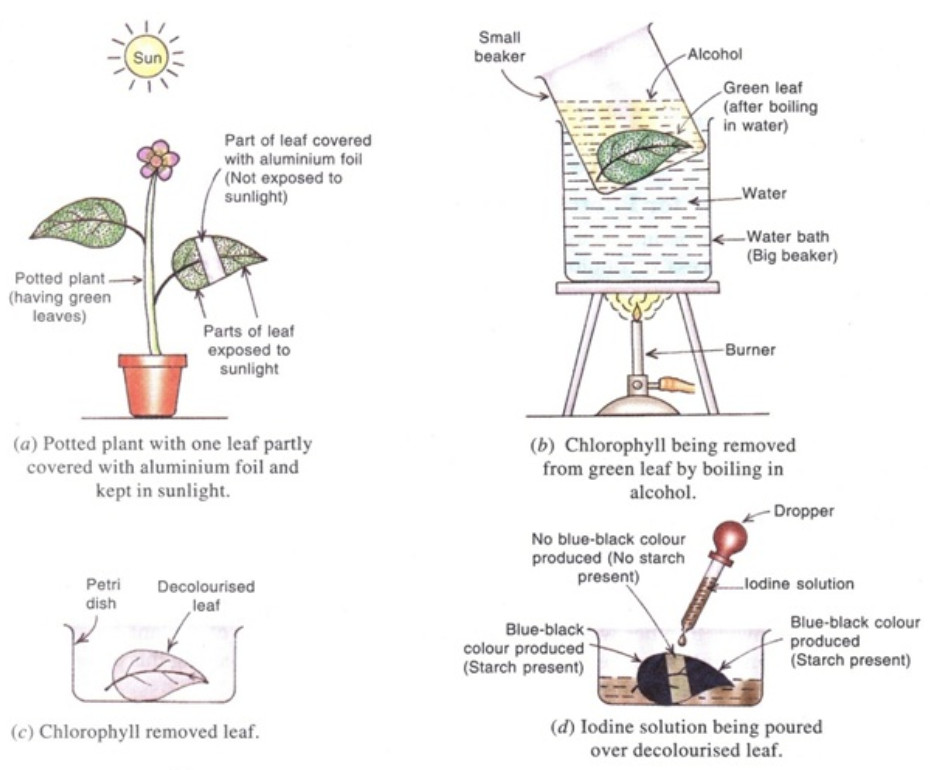
- Keep a potted plant in a dark room for 2-3 days to destarch its leaves.
- Cover the middle portion of a leaf with a strip of black paper or aluminium foil.
- Expose the plant to bright sunlight for 3-4 hours.
- Perform the Iodine test on the leaf.
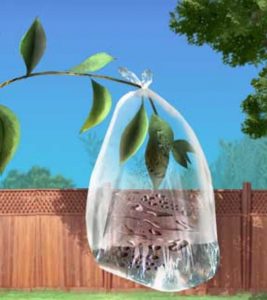
- Take a healthy potted plant. Enclose a leafy branch inside a clean transparent polythene bag and tie its mouth.
- Place the plant in sunlight for 2-3 hours.