Question 1 Show covalent bonding in hydrogen molecule?
Question 2 Show covalent bonding in oxygen molecule?
Question 3 Show covalent bonding in nitrogen molecule?
Question 4 Show covalent bonding in chlorine molecule?
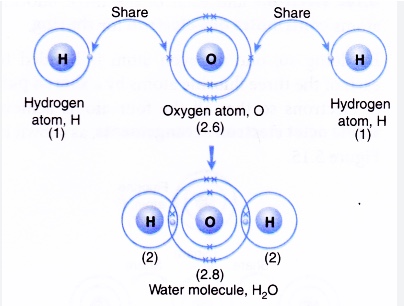
Question 5 Show covalent bonding in water molecule?
Examples of covalent molecules
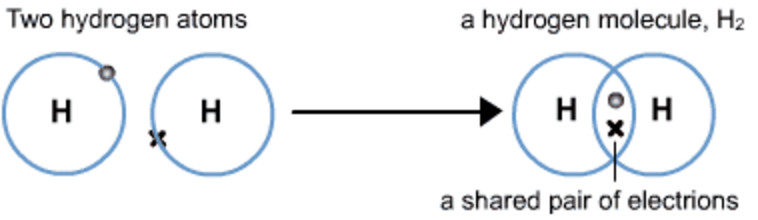
(1) Hydrogen molecule
The atomic number of hydrogen is 1. Hence hydrogen has one electron in its K shell and it requires one more electron to fill the K shell. So two hydrogen atoms share their electrons to form a molecule of hydrogen, H2 . This allows each hydrogen atom to attain the electronic configuration of the nearest noble gas, helium, which has two electrons in its K shell. We can depict this using dots or crosses to represent valence electrons.
The shared pair of electrons is said to constitute a single covalent bond between the two hydrogen atoms. A single covalent bond is also represented by a line between the two atoms.
(2) Oxygen molecule
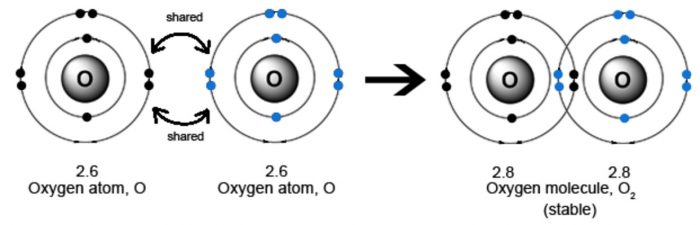
The atomic number of oxygen is 8.Its electronic configuration is 2 , 6. It has 6 electron in its outermost shell.It needs 2 more electron to complete its shell.Therefore O atom shares its electron with another oxygen atom.Thus there is a double covalent bond.
(3) Nitrogen molecule
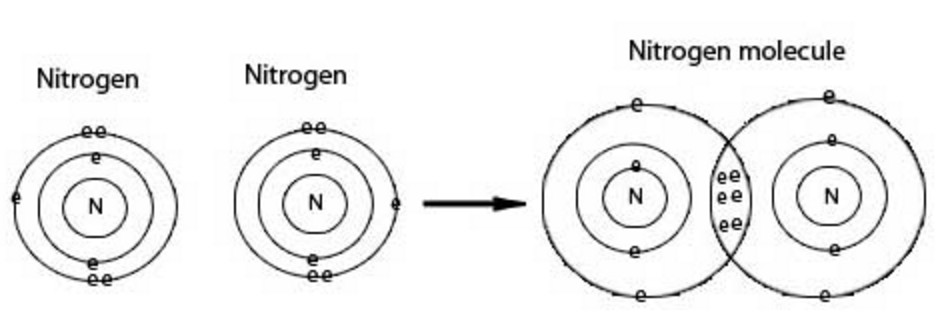
The atomic number of nitrogen is 7.Its electronic configuration is 2 , 5. It has 5 electron in its outermost shell.It needs 3 more electron to complete its shell.Therefore N atom shares its electron with another nitrogen atom.Thus there is a triple covalent bond.
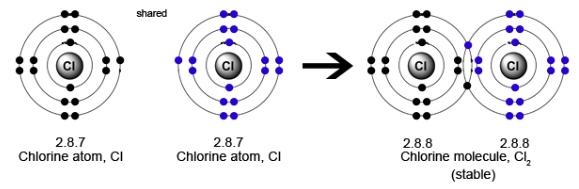
(4) Chlorine molecule
The atomic number of chlorine is 17 . Its electronic configuration is 2, 8 , 7 . It has 7 electron in its outermost shell.It needs 1 more electron to complete its shell.Chlorine gets this electron by sharing with another atom. So each chlorine atom shares one electron to form a chlorine molecule.Thus there is a single covalent bond.
(5) Water molecule
The atomic number of Hydrogen is 1 .Its electronic configuration is 1.
The atomic number of oxygen is 8 .Its electronic configuration is 2 , 6.
Two hydrogen atoms each share their 1 electron with oxygen to form two covalent bonds and make a water molecule.
or
One oxygen atom shares its two electrons with two hydrogen atoms.