Question 1 State ohm’s law?
Question 2 What is the resistance of an electric arc lamp, if the lamp uses 20 A when connected to a 220 Volt line?
Question 3 Define resistance of a conductor. What is its SI unit?
Question 4 Write the formula which relates electric current, time and electric current?
Question 5 What kind of plot would you expect when current is plotted against potential difference?
Question 6 What happens to the resistance as the conductor is made thinner?
Question 7 What is the SI unit of resistance?
Question 8 What is the use of rheostat?
Question 9 Define the term variable resistance?
Question 10 What is a good conductor?
Question 11 What is a bad conductor?
Question 12 What are insulators?
Ohm’s Law
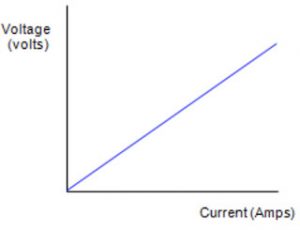
George Simon ohm(in 1826)studied relationship between I and V across the ends of conductor.
Ohm’s Law states that electric current flowing in a conductor is directly proportional to potential difference across the ends of the conductor, provided temperature and other physical conditions remains constant.
V=IR
R=Resistance of conductor
Resistance of a conductor is the property of conductor to oppose the flow of charge through it.
R = V/I
Unit of resistance is ohm
1 ohm = 1 Volt / 1 Ampere
Resistance of a conductor is said to be 1 ohm if a potential difference of 1 volts across the ends of conductor makes a current of 1 ampere to flow through it.
Slope = I / V
Slope of graph V and I=Resistance of a conductor
V=IR
I= V/R
If R is halved then I is doubled.
If R is doubled then I is halved.
In an electric circuit, sometimes current has to be increase or decrease. A component used in an electric circuit to change the current without changing the potential difference across the circuit is called variable resistance.
Rheostat is a device used in electric circuit to change the resistance and hence current in circuit.
A conductor or material which offers low resistance to the flow of electrons or electric current in an electric circuit is called as good conductor.
A conductor or material which offers higher resistance to the flow of electrons or electric current in an electric circuit is called as bad conductor.
A material which offers very high resistance to the flow of electrons or electric current in an electric circuit is called as insulator.